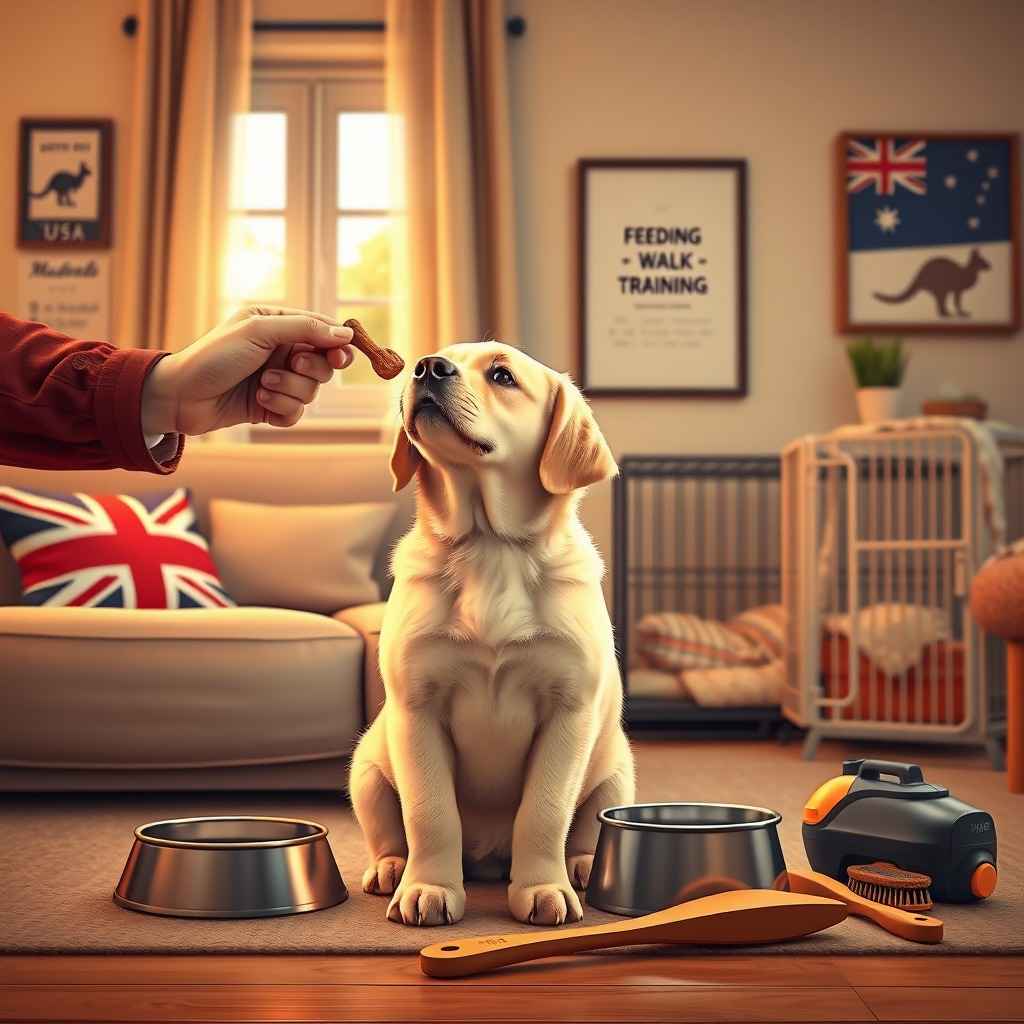
Welcoming a puppy into your home is one of life’s greatest joys—but also a big responsibility. Whether you’re in the United Kingdom, United States, or Australia, laying a strong foundation in training not only shapes a well‑behaved dog but strengthens the bond you share. In this in‑depth guide, we’ll walk you through proven techniques—from potty training and basic commands, to socialisation and grooming—all while weaving in region‑specific insights and legal considerations. You’ll get expert tips, case‑studies, pros and cons, and quick stats (like the RSPCA’s fact that one in four UK households owns a dog). Ready to turn that playful puppy into a polite four‑legged companion? Here’s everything you need, globally informed and locally tailored.
Establishing a Routine: The Foundation of Puppy Success
(300–400+ words)
Quick Answer: A consistent daily routine with scheduled feeding, potty breaks, play, and sleep sets your puppy up for behavioural success—essential across the UK, US, and AU!
Creating a daily pattern may seem obvious—but its impact on puppy training is profound. Puppies thrive when they know what to expect. Here’s why routine matters and how it varies by region:
Why routine matters
- Reduces anxiety: Predictability helps a puppy feel secure.
- Streamlines house training: Knowing when to expect potty breaks shortens accidents.
- Supports your lifestyle: Whether you work typical US hours or follow UK childcare schedules, aligning puppy time matters.
- Enhances training retention: Short, consistent practice sessions stick better.
Components of a daily routine
- Feeding schedule – 3–4 small meals daily, based on UK Kennel Club, US AVMA, and RSPCA guidelines.
- Potty breaks – Aim for every 2–3 hours, especially post‑meal and nap.
- Training slots – 5–10 mins, 2–3 times per session; suitable for mental stimulation.
- Socialisation & exercise – Include daily walks, play, and exposure to new environments.
- Sleep/rest periods – Puppies sleep up to 18 hrs/day; crate training helps.
UK-specific insight
- UK law (Animal Welfare Act 2006) mandates mental and physical stimulation—your routine must reflect that.
- According to GOV.UK, regular exercise supports legal welfare requirements.
Real-life case study
Case Study: Emily in Leeds, UK
Emily introduced a daily “pup calendar” at eight weeks old—each slot labeled “feeding,” “outdoor,” or “training.” Within two weeks, her Labrador responded to cues, and accidents dwindled. The structure aligned with her work-from-home schedule—proving that a routine can support lifestyle and canine wellbeing.
Pros and Cons of rigid routines
| 👍 Pros | 👎 Cons |
| Builds security and trust | May feel inflexible for irregular schedules |
| Reduces accidents and stress | Can cause stress if disrupted |
| Creates predictable training opportunities | Might require adjustment post‑vacation |
Insight: RSPCA emphasises “regular, predictable routines” as key to puppy behavioural stability.
House‑Training & Crate Training Across Regions
(300–400+ words)
In short: House‑training and crate training go hand in hand—work together to reduce accidents, create a safe den, and aid emotional development. Adapted to each region’s legal and housing norms.
1. Potty training fundamentals
- Frequency: Every 2 hrs for puppies ≤12 weeks.
- Cue pairing: Use verbal cues like “Go potty” to build association.
- Consistent location: Keeps learning focused.
- Positive reinforcement: Praise, treats, and timing matter.
Regional note:
In Australia, apartment living is common—train lifts and communal areas early. In rural US or UK homes, training in yards may require better recall training before off‑lead time.
2. Crate training benefits
- Creates a secure safe zone
- Aids bathroom control by leveraging a dog’s instincts
- Supports travel and vet visits
Pro tip: Use slow introduction: leave door open with toys/snacks, then gradually increase closed-door time.
3. Legal & welfare considerations
- UK: Under the Animal Welfare Act, puppies must have safe, sheltered areas
- US & AU: Many states/territories require appropriate shelter and confinement
- Use the Kennel Club’s guidance on kennel size and care in the UK
- Check with AVMA (US) or RSPCA (AU) for housing standards
Positive Reinforcement & Command Training
(200–300 words)
Integrating reward‑based training builds cooperation and joy. Puppies learn best when eager to please—but not overwhelmed.
- Commands: “Sit,” “Stay,” “Come,” “Leave it,” “Down.”
- Training tips:
- Use rewards within 1 sec of action.
- Keep sessions to 5–10 mins.
- Use the same command word and tone consistently.
- Use rewards within 1 sec of action.
- Expert insight:
“Positive reinforcement is the only approach shown to reliably promote both learning and welfare,” says the RSPCA. - Case study: A Cairn Terrier puppy in Sydney mastered “Come” in two days with daily 5‑minute bursts, using practice in different rooms and outdoors.
Socialisation Strategies & Region‑Specific Advice
(300–400+ words)
Quick Answer: Well‑socialised pups become confident, friendly dogs—essential in diverse environments like UK city spaces, US dog parks, or Aussie beaches.
What is socialisation?
Exposing puppies to people, animals, places, sounds, textures, and experiences between 3–16 weeks builds resilience and adaptability.
UK-specific angle
- The RSPCA and GOV.UK recommend visits to places like pubs-with-patios, schools, and public transport for developing calmness in new settings.
- Many UK homeowners use private puppy socialisation classes—check local RSPCA or Kennel Club listings.
US perspective
- Dog parks, obedience clubs, and vet‑run puppy programs abound.
- Consider local leash laws and park etiquette—e.g., owner responsibility in Denver, Seattle.
Australian practices
- Socialising at off-leash beaches and bush parks is common, but always check local council restrictions.
- Surf clubs in cities like Melbourne or Sydney often host puppy-friendly events.
Tips for safe socialisation
- Ensure all vaccinations are up‑to‑date before dog-dog interactions
- Use disinfected indoor venues where gravel/sand limits risk
- Introduce new experiences at a pace your puppy handles
- Aim for at least 10–15 mins daily of novel experience
Pros & Cons
| 👍 Pros | 👎 Cons |
| Builds confidence | Risk of overstimulation |
| Prevents fear/anxiety | Vet visit costs |
| Enhances owner‑puppy bond | Needs strict supervision |
Grooming & Healthcare Considerations
(300–400+ words)
In short: Grooming isn’t just about looks—it’s vital for health, especially under weather conditions in the UK, US, or AU.
1. Grooming frequency
- UK: Many dogs require grooming every 4–6 weeks; double coated breeds need extra brushing.
- US: Puppy-specific grooming services are common around 4–5 mos—Fleas and ticks need attention in warmer states.
- AU: Hot summers demand regular nail and coat trims to prevent overheating.
2. Hygiene checks
- Ears: Clean weekly to prevent UK’s increasing cases of ear infections in breeds like Cocker Spaniels
- Teeth: Start brushing early; AVMA suggests brushing 2–3 times weekly
- Nails: Trim every 2–4 weeks depending on activity
3. Vet & vaccination schedules
Ensure core vaccines:
- UK/AU: DHPPi (distemper, hepatitis, parvovirus), leptospirosis
- US: DHPP and Bordetella per AVMA guidelines
Include socialisation-friendly vaccines—many puppy social classes require them.
Expert Quote
“A balanced grooming routine supports both physical health and emotional resilience,” says UK dog grooming association official.
Quick fact
AVMA reports: 80% of US dogs show dental issues by age three if oral care is ignored.
Nutrition & Feeding Guidelines
(300–400+ words)
Quick Answer: Balanced meals tailored for puppy growth stage, breed size, and region-specific nutritional standards ensure your pup develops strong bones, immune health, and energy.
Nutritional basics
- Choose complete puppy food (UK’s “Complete and Balanced” label, US AAFCO, AU Pet Food Industry Association standards).
- Adjust portions using guidelines; weigh puppy monthly.
- Add variety with US-sourced freeze-dried toppers, UK’s cooked pure pumpkin, or AU kangaroo treats in moderation.
UK legal note
Under the Animal Welfare (Sentencing) Act, manufactured pet food must meet welfare standards—look for “complete feed” indicators on packaging.
Feeding schedule
- 8–12 weeks: four meals/day
- 3–6 months: three meals/day
- Over 6 months: two meals/day
Case Study
Jack, a pup in Brisbane, switched from generic kibble to a certified complete puppy diet (Petcurean GO-DOG), improving coat shine and reducing stool volume.
Pros & Cons
👍 Pros: Growth support, better stool, fewer allergies
👎 Cons: Costlier, watch for overfeeding with treats
Common Challenges & Solutions
(300–400+ words)
In short: From barking and chewing to separation anxiety, know the why, how and best-practice solutions to tackle common puppy hurdles.
- Excessive barking
- Cause: Boredom, fear, attention – respond with ignore–reward method.
- UK tip: Public noise laws encourage quiet training inside.
- Cause: Boredom, fear, attention – respond with ignore–reward method.
- Chewing & nipping
- Cause: Teething or curiosity.
- Fix: Doggy chew toys; teach “Leave it.” Avoid punishment.
- Cause: Teething or curiosity.
- Separation anxiety
- Signs: Whining, destruction.
- Approach: Gradual departures; short stays with calming toys.
- Signs: Whining, destruction.
- Food/potty regressions
- LINK: Illness, stress.
- Vet action: Rule out GI, adjust routines.
- LINK: Illness, stress.
- Pulling on lead
- Use front‑clip harnesses and reward good walking; many Aussie vets recommend stop‑and‑go method.
- Use front‑clip harnesses and reward good walking; many Aussie vets recommend stop‑and‑go method.
FAQs
Can I give carrots to my dog in the UK?
Yes! According to RSPCA, cooked or raw carrots are safe for UK dogs—rich in fibre and vitamins. Just serve in bite‑sized pieces to avoid choking and don’t exceed 10% of daily caloric intake.
When do I start toilet training my puppy
Begin toilet training between 8–12 weeks. Puppies should go outside every 2–3 hours—after meals, naps, play. Consistent cues, outdoor practice, and praise are essential to success.
How often should I groom my puppy in Australia?
In AU, grooming every 4–6 weeks is recommended for most breeds. During hot seasons, trim fur lightly and brush 2–3 times weekly to prevent matting and overheating—especially in northern states with extreme heat.
Why is socialisation important in the US?
Socialisation helps puppies adapt to new people, places, and environments—a vital step to curb fear-based behaviour. Many US vets recommend structured puppy classes between 8–16 weeks, ideally after core vaccines.
What’s the difference between UK and US puppy vaccination schedules
Both follow core vaccines like DHPP. In the UK/AU, leptospirosis is often included; US schedules may also include Bordetella (kennel cough). Consult your vet for region‑specific guidance tailored to your area.
Final Thought
Training a puppy across the UK, US, and Australia shares core principles: routine, positive reinforcement, proper nutrition, grooming, and socialisation. Differences lie mainly in legal standards, climate‑based care, and local customs—but the goal remains universal: a happy, healthy, well‑connected canine companion. By combining expert advice (GOV.UK, RSPCA, AVMA) with real‑world strategies, you’ll be well equipped to raise a confident dog anywhere in the world.
Author Bio
Hi, I’m Lucille L Fisher, 50 years old, a passionate pet nutritionist and pet care expert with 6 years of experience raising healthy dogs and cats across the UK, US, and Australia. I believe homemade food and responsible pet ownership can transform animal lives when done properly. Always consult your local vet before making changes to your pet’s diet, care, or medical routine.
Internal Links
- Check out our UK Puppy Socialisation Checklist
- Discover our guid